
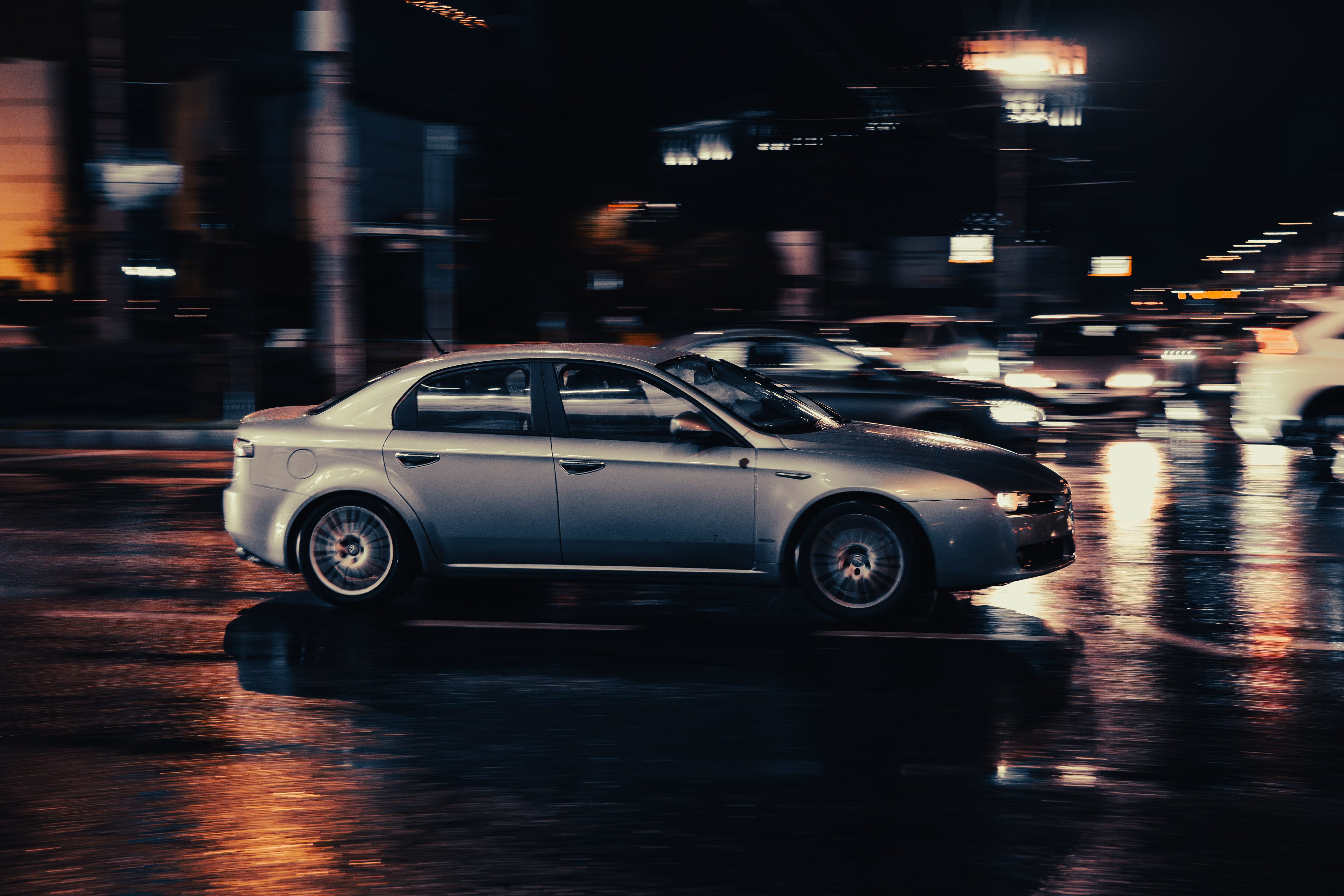


What is dynamic tracking?

  • What lens did I use? Why did I use this lens?
  • Shutter speed – the main player
  • Positioning – angles of approach
  • Continuous Servo – a Must!
  • How do I actually take the shot?

What is dynamic tracking?

Dynamic tracking of a moving subject is a commonly used technique in motion photography. It is frequently encountered in sports photography. In familiar terms, we have a sharp subject, followed while moving, and a blurred background caused by panning the camera in the direction of the subject. This provides a dynamic effect that conveys a sense of speed.

What lens did I use? Why did I use this lens?

For the photos below, I used a telephoto lens (Nikkor 55-200mm) with a focal length ranging from 55 to 200mm. This gives me a fairly wide minimum angle, so I don’t have to step too far back from the subject when nearby, while also allowing me to zoom in optically. This way, I can “get closer” to the subject without losing image quality, since the zoom is mechanical, not a sensor crop.

Shutter speed – the main player

When discussing shutter speed, I consider it a very volatile value, closely tied to several factors:

  1. Subject speed
  2. Distance to the subject

I believe real-time adaptability is key and comes with experience. However, I’ll throw in a starting value to play with, adjust as needed based on results: at a distance of 10–20 m: 1/50.

Obviously, we’ll use shutter priority mode. ISO should be adjusted based on the required light. I recommend not going over 600, with 800 as the maximum acceptable value.

As a basic rule, the faster the subject, the shorter the shutter speed (e.g., 1/50 → 1/60); the closer the subject, the longer the shutter speed can be (e.g., 1/50 → 1/40).

Positioning – angles of approach

It all depends on my location. If my subjects are traffic vehicles, I’ll try to position myself so that when the car is perpendicular to the lens (at the minimum focal length, no zoom), I can fully capture it in frame. This ensures I’m maximizing my lens capabilities and not missing any shots.

Continuous Servo – a Must!

The most important thing before shooting is to set the focus mode to continuous servo. This way, the camera constantly adjusts the focus to keep the subject sharp.

How do I actually take the shot?

You have to accept that out of 100 shots, you might end up with just a few usable ones—and maybe one truly successful photo! Still, there are a few techniques to maximize efficiency.

Let’s use the example of a car moving toward us. I try to focus on a fixed point on the car and follow it continuously while holding the shutter button halfway, keeping the focus locked. The goal of following a fixed and clear point is to move the camera at the same speed as the car relative to me. This way, the background will be blurred, and the car sharp—ideally.

Even more, I recommend going out to an open square and just playing around. Below are some successful examples with their specific settings.

f/14; 1/40; ISO-640;

f/10; 1/50; ISO-640;

f/9; 1/50; ISO-640;

f/13; 1/40; ISO-640;

f/10; 1/50; ISO-640;

f/11; 1/50; ISO-640;