
In the following, we will explore the indoor photography capabilities with a Nikon D5300, using the built-in flash.

  • In which format should I shoot? JPEG or RAW?
  • Light – the main enemy
  • Which lens did I use? Why did I choose this lens?
  • Advantages and disadvantages of a very wide aperture?
  • ISO values and exposure time – how much can I push the pedal?
  • Background lights – the great enemy or the only hope for a clear subject?
  • Single Point Focus or Area Focus? Why do I get blurry subjects?
  • Manual focus – an unexpected friend?
  • Manual mode – when can it save me from trouble?

In which format should I shoot? JPEG or RAW?

I will start the article with a brief description, as this is not the purpose of this post, about the necessity of using the RAW format. As a general rule, as long as I’m not in a tight situation where space is an issue, we will exclusively use the RAW format for photos. The reason is that it stores more “photographic information” that I can manipulate during post-processing. Photos in low light depend heavily on how we develop them at home. Therefore, I need as much information as possible to work with to “illuminate” the subjects later.

Light – the main enemy

The first thing we encounter when faced with indoor settings is the lack of light. What we perceive with our eyes may initially seem sufficient, but due to the human eye’s adaptation to low light, we are actually in great error. I will notice that my subjects are lost in complete darkness. This doesn’t mean that the clearly underexposed photo is unusable! This is where what I mentioned earlier comes into play: using a format with a lot of information. We will discuss below how to achieve the best levels of detail.

Which lens did I use? Why did I choose this lens?

I paired this D5300 body with a 35mm Nikkor lens. This is a prime lens. In short, optical zoom is no longer an option. However, I gain a significant advantage. A prime lens, due to its simplicity, produces a much clearer, naturally sharper image. Furthermore, its most important advantage is the ability of the aperture to open very wide, in our case up to f/1.8. This means a large amount of light enters the lens, which is essential for indoor shots. Additionally, its 35mm focal length provides a wide frame, an advantage in tight spaces.

Advantages and disadvantages of a very wide aperture?

I praised the f/1.8 aperture above, which allows me to capture brighter photos. However, with an excessively wide aperture, a problem arises: an exaggerated bokeh effect that can work against me. What does this mean? The wider the aperture, the more blurred everything behind or in front of the subject—outside the focus point—becomes. This can lead to very interesting effects if used correctly. To achieve this, I need all subjects (for example, in a frame with two people) to be on the same plane, meaning at the same distance from the camera. With a very wide aperture, if one subject is even 10-15 cm behind the focus point, they start to appear blurred. Thus, getting all subjects sharp in a group photo becomes almost impossible to achieve.
But that’s not all! Problems can arise even when my subject is a single person. Imagine photographing someone in profile, with their face at an angle to the lens; I might get one part of the face sharp and another part blurred. If I focus on the right eye, the area around the left eye might become blurry. I’ll provide an example below. We’ll discuss solutions toward the end of the article.

ISO values and exposure time – how much can I push the pedal?

Now, let’s get to the core. What values can I work with? I’ll start with exposure time, as it’s more intuitive. An exposure time of 1/x means my aperture stays open (to let light in) for 1/x of a second. So, when I use an exposure time of 1/100, the aperture stays open for a hundredth of a second, during which light enters the lens. This value needs to be adjusted based on necessity. For example, if my subjects are posing still, I can increase the exposure time for a brighter photo, as their movement will be minimal, say 1/200. If I want to photograph someone in the middle of a dance, I’ll need to lower the exposure time to avoid capturing them blurry. Depending on the energy of the dance, a time of 1/500 will serve me better. Although I sacrifice some light, the subject appears “frozen,” captured in the moment.

ISO? What is ISO? The ISO value represents the film’s sensitivity. In short, the higher the value, the more light I get. However, it’s not that simple. A very high ISO will result in a noisy image. As a general rule, I advise not exceeding an ISO of 1000, except in exceptional cases where I have no other options. Personally, I find 800 to be the maximum usable value with results that aren’t bothersome.

    Background lights – the great enemy or the only hope for a clear subject?

Due to the lack of light on the subject, the camera will focus where it “sees.” So, when there’s a brighter, more intense light behind the subject, the focus automatically shifts there, as can be seen in the attached image below. Since the blue panel is slightly reflective, the sensor is tricked, and the focus shifts to it. However, there are two solutions that, when combined, can get us out of this mess.

Single Point Focus or Area Focus? Why do I get blurry subjects?

One solution is switching to Single Point Focus. This way, we tell the camera to focus on a point that we can manually place on the subject.

     Manual focus – an unexpected friend!

We can assist the software by switching the lens from AF to M/AF. By rotating the focus ring, we can “suggest” to the software where to focus.

Manual mode – when can it save me from trouble?

I will conclude the article with a suggestion to use Manual Mode.

Personally, I shoot 90% of the time in Shutter Priority mode. This way, I set the desired exposure time and ISO, and the camera adjusts the aperture automatically. I ensure that my subjects aren’t blurry and that I have constant control over the dynamics of the photos. However, in low light, even with the flash on permanently, the camera gets “scared” and opens the aperture to the maximum, and rightfully so. But, as I mentioned earlier, a very wide aperture can lead to blurry subjects with a very small margin of error. Thus, with manual mode, I can avoid such issues. In real-life situations, I rely heavily on the flash as a light source, preferring to sacrifice some “natural” light to achieve a clear subject.

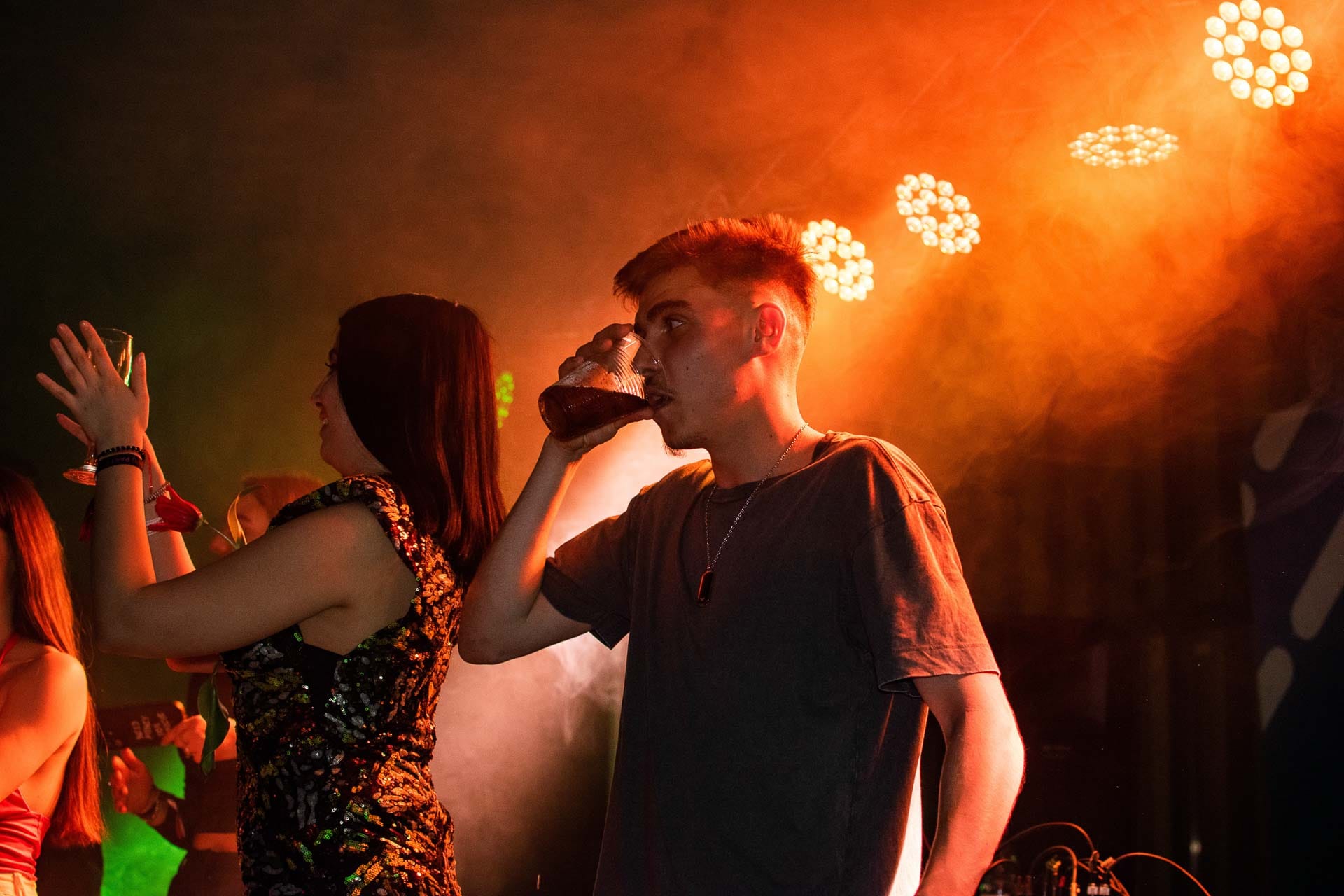
Below, I will provide several successful examples:

f/2.8; 1/200; ISO-800

THE FOLLOWING EXAMPLES WERE SHOT IN THE FORMAT: f/3.5; 1/200; ISO-800